The Meeting Agenda Myth: More Topics Do Not Mean More Progress
A focused meeting agenda groups topics by purpose, helping people follow the discussion, make decisions and leave with clear next actions.
A focused meeting agenda can stop a planning call from turning into a queue of unrelated updates. Instead of treating the page as a container for every suggested topic, use it to show what kind of conversation each item calls for and how the subjects fit together.
That means looking beyond the heading. A useful agenda helps participants distinguish listening from debating, and debating from committing. It also gives the chair a simple way to keep the conversation on course without shutting down a relevant concern.
What should the group accomplish together?
Start with the reason people need to meet. Perhaps they must compare views on a shared problem, make a choice that affects several people, or coordinate work that depends on more than one person. Write that purpose in plain language before collecting agenda items.
This is a practical boundary, not a grand mission statement. If one person can send an update and no response is needed, it may not need meeting time. If the group must react, name the reaction: for example, “Flag questions about the revised rota” is clearer than “Rota update”.
A broad subject such as “website launch” could mean sharing a status, exploring a concern or choosing which page to publish first. Those conversations need different preparation and different facilitation. Name the work the group is being asked to do, rather than leaving participants to infer it from the subject.
Which kinds of conversation belong on the agenda?
Sort proposed items by the role participants need to play. These labels can help:
- Inform: share context without inviting a broad discussion.
- Explore: compare views or clarify a question before choosing.
- Decide: select an option or settle a question the group has authority to resolve.
- Coordinate: agree how people’s responsibilities or work connect.
- Review: consider what happened and what the group might change.
A topic can need more than one kind of conversation, but the stages should be visible. An exploration may prepare the ground for a decision later; that does not mean the group should treat the first discussion as a vote.
Order items according to what participants need to understand first. Put essential context before the discussion that uses it, and leave coordination until people know what they are agreeing to support. This makes the agenda’s sequence meaningful without forcing every meeting into the same pattern.
How can an agenda item make its purpose clear?
Use a heading that describes the group’s task. “Reader letters” names a subject; “Choose which reader letters need an editorial reply” describes a decision. Keep the wording open enough that it does not smuggle in an answer.
Add only the context people need to take part: the question, relevant material and who is bringing it. For a decision, identify the options under consideration. For exploration, state what the group needs to understand. If a document contains background detail, link to it and say what participants should look for.
Check that the heading matches the intended conversation. “Choose a supplier” implies that the group is ready and able to decide; “Compare supplier proposals” describes an earlier stage. If the choice is not ready, make the preparation or discussion the agenda item instead.
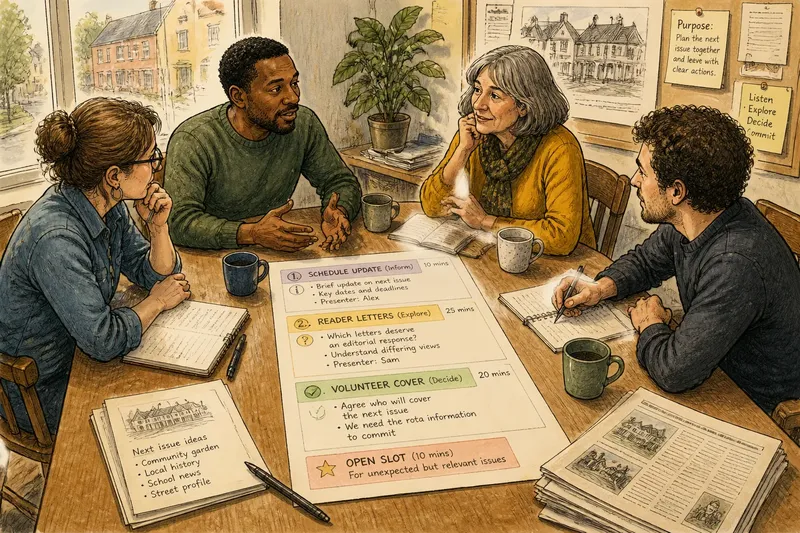
Say you are preparing a fictional planning meeting for a neighbourhood newsletter team. The starting list is “issue schedule”, “reader letters” and “volunteer cover”. You turn the first into a brief schedule update, the second into a discussion of which letters deserve an editorial response, and the third into an agreement about who will cover the next issue. The resulting agenda makes clear that the letters item is exploratory, while the cover item calls for a commitment; if the team lacks the rota information, it can defer that commitment and name the missing information.
How do you keep the agenda focused?
Look for repeated topics, items that belong in another conversation, and announcements that need no response. Combine overlapping suggestions under one precise heading. If a subject contains several questions with different purposes, split it so participants know which question they are addressing.
Give attention according to the work involved, not according to how tidy a timetable looks. A short update may need little discussion; a difficult choice may need room for questions and disagreement. If the group cannot reasonably address everything, move an item to a note, another meeting or an individual follow-up rather than letting it crowd out the central work.
An open slot can help a group handle an unexpected issue, but it needs a boundary. Decide what kinds of matters belong there and what should be taken elsewhere. It is not worth colour-coding every item or polishing elaborate labels if people still cannot tell what they are meant to do. Plain headings and a readable order are enough.
How can the chair keep each discussion on track?
Send the agenda with the material people need to prepare. At the start of each item, briefly name its purpose: “We’re comparing options, not choosing one today.” That cue can prevent an exploratory discussion from becoming an accidental vote.
If a new subject appears, ask whether it serves the current item. A useful concern may change the conversation, but related does not always mean relevant right now. Capture a separate issue and agree who will raise it in the right setting, rather than dismissing it or allowing it to take over.
As an item closes, say what the group has settled, what remains open and who is taking any agreed action. If no decision was possible, identify what needs to happen before the issue returns. These spoken cues help participants understand the shape of the meeting as it unfolds.
What questions do people ask about a meeting agenda?
Does every agenda item need a decision?
No. Some items are for sharing context or understanding a problem before the group can choose. State that purpose so people do not arrive expecting a vote.
What if a topic needs both discussion and a decision?
Show the stages separately, even if they happen in one meeting: explore the issue, then decide only if the group has enough information and authority. If it is not ready, record what is missing and who will bring it forward.
How many topics should a meeting agenda include?
There is no universal number that fits every group. Include the topics people can give proper attention to, and move the rest to a note, another meeting or a follow-up with the relevant person.
What should happen to an item that is not ready?
Replace the implied decision with the specific discussion or preparation that is possible, or defer it. Name what must happen before it returns so the group can distinguish a deliberate pause from a forgotten subject.
How can you judge whether the agenda helped?
After the meeting, ask whether participants understood the purpose of each item and whether the chair could guide the discussion without constant clarification. Notice where the conversation wandered or stalled. The agenda may have combined two different tasks, placed a decision before its context, or promised a choice the group could not make.
Use that observation to shape the next agenda. Perhaps an update should be sent in advance, or a decision needs an earlier discussion. A focused meeting agenda is most useful when its wording and order help people recognise what kind of conversation they are having, and what the group has agreed to do before it moves on.